

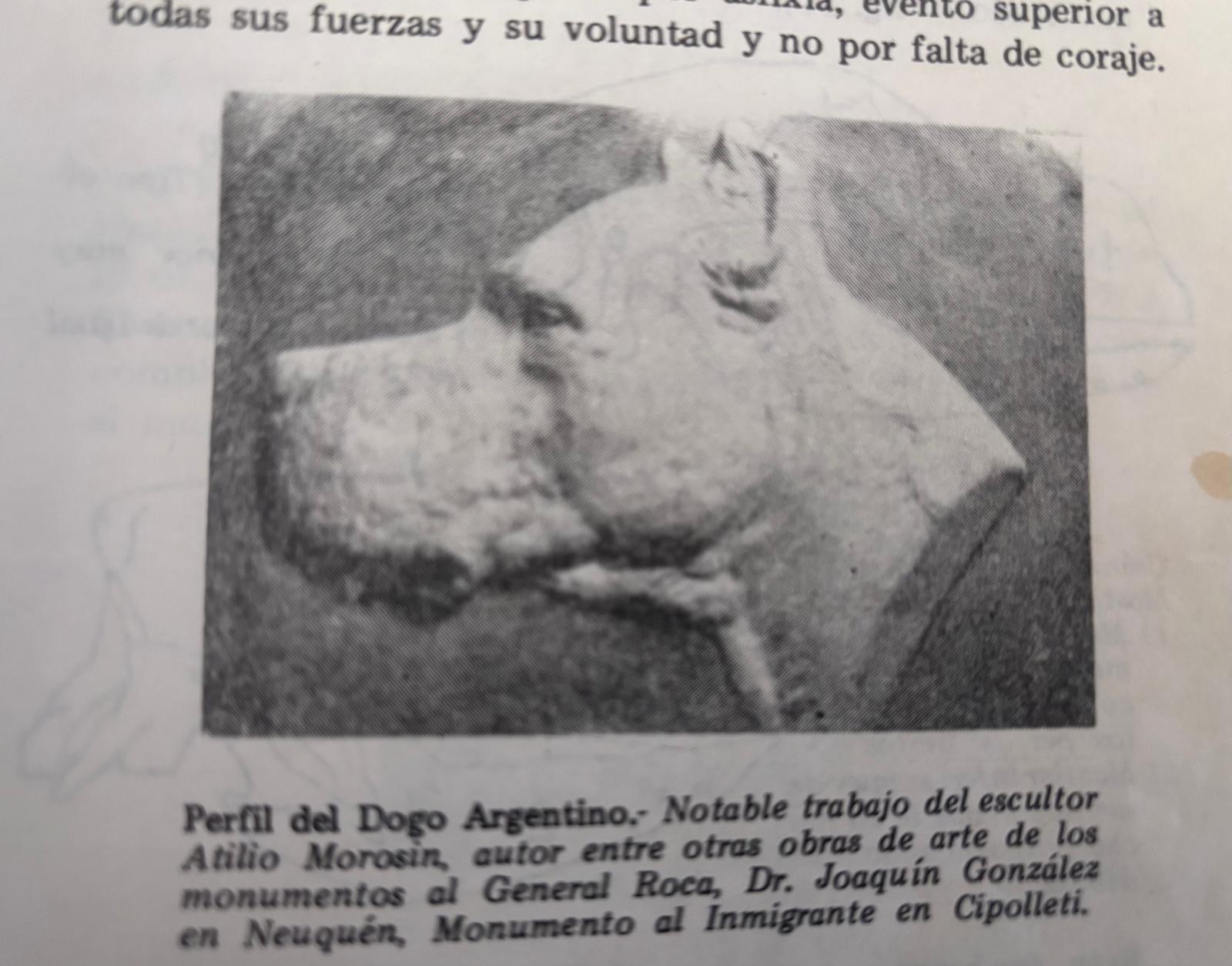
La conformación física y anatómica del Dogo Argentino
El capítulo IV de la obra de Agustín Nores Martínez (Editorial Albatros, 1982) es un verdadero tratado de morfología, en el que el autor fija los rasgos distintivos de la raza con rigor científico y pasión cinófila.
El Dogo Argentino está concebido como un perro mesomorfo, armónico y potente, construido para la resistencia y para la presa. Su estructura es el resultado de un proyecto genético que ha unido funcionalidad venatoria y belleza plástica.
La cabeza
La cabeza es maciza pero proporcionada, con cráneo amplio y hocico fuerte, capaz de sostener una dentadura completa y regular. Las mandíbulas cierran en tijera, garantizando firmeza y tenacidad. Los ojos, oscuros y bien distanciados, transmiten vivacidad e inteligencia. Las orejas, antaño cortadas para la caza, hoy pueden llevarse naturales, de longitud media y adherentes.
El tronco
El cuello es robusto, musculoso, sin papada, y se inserta armoniosamente en el tórax. Este último es amplio y profundo, con costillas bien arqueadas que aseguran gran capacidad respiratoria. La línea dorsal es recta y sólida, mientras que la grupa, ligeramente inclinada, favorece el impulso y la agilidad.
Los miembros
Los anteriores son rectilíneos y vigorosos, con hombros oblicuos y musculosos; los posteriores, potentes y bien angulados, garantizan equilibrio y fuerza en la carrera y en el ataque. Los pies son compactos, con dedos fuertes y uñas resistentes, adaptados al terreno duro y a las largas jornadas de caza.
La piel y el manto
La piel es gruesa, el pelo corto y completamente blanco: un signo distintivo que no es solo estético, sino también funcional, pues permite identificar al perro incluso a distancia durante la caza.
✒️ Comentario
El capítulo IV no es únicamente una descripción anatómica: es la visión de un perro ideal, moldeado para encarnar fuerza, resistencia y armonía. Cada detalle morfológico tiene una función precisa, y juntos componen la imagen de un atleta natural, capaz de enfrentar la caza y la defensa con la misma eficacia.
Agustín Nores Martínez nos muestra cómo la morfología del Dogo Argentino es la traducción anatómica de una función: el cuerpo convertido en herramienta de trabajo y de fidelidad. La cabeza amplia y poderosa no es un capricho estético, sino la garantía de una presa segura; el tórax profundo es el respiro de la resistencia; los miembros sólidos y proporcionados son la promesa de velocidad y agilidad. El manto blanco uniforme se convierte en sello distintivo y funcional, un emblema que permite reconocer al perro en plena acción.
Esta conformación es el resultado de una selección rigurosa, donde nada se deja al azar. No se trata de un perro pesado ni ligero, sino de un equilibrio perfecto entre fuerza y movilidad. Es la armonía de las proporciones lo que lo hace único: un atleta natural, preparado para enfrentar presas de gran tamaño y resistir las pruebas más duras.
El Dogo Argentino, así descrito, es mucho más que un conjunto de rasgos anatómicos: es un organismo concebido para la función, un cuerpo que habla el lenguaje de la caza y de la defensa. Su elegancia no es ornamental, sino fruto de la disciplina de la fuerza, de la necesidad de unir belleza y utilidad.
En esta visión, la morfología se convierte en el manifiesto de una raza nueva, original y argentina. Cada línea del cuerpo refleja la idea central de Nores Martínez: el Dogo no es un experimento estético, sino una raza con un destino preciso, moldeada para servir al hombre en la caza, en la guardia y en la vida familiar.
The Physical and Anatomical Conformation of the Dogo Argentino
Chapter IV of the work by Agustín Nores Martínez (Editorial Albatros, 1982) is a true treatise on morphology, in which the author establishes the distinctive traits of the breed with scientific rigor and canine passion.
The Dogo Argentino is conceived as a mesomorphic dog, harmonious and powerful, built for endurance and for prey. Its structure is the result of a genetic project that has united hunting functionality with aesthetic beauty.
The Head
The head is massive yet proportioned, with a broad skull and strong muzzle, capable of supporting a complete and regular dentition. The jaws close in a scissor bite, ensuring firmness and tenacity. The eyes, dark and well-spaced, convey liveliness and intelligence. The ears, once cropped for hunting, can now be left natural, medium in length and close-fitting.
The Trunk
The neck is robust, muscular, without dewlap, and harmoniously inserted into the chest. The latter is broad and deep, with well-arched ribs that ensure great respiratory capacity. The topline is straight and solid, while the croup, slightly sloping, favors drive and agility.
The Limbs
The forelimbs are straight and vigorous, with oblique, muscular shoulders; the hindlimbs, powerful and well-angulated, guarantee balance and strength in running and attacking. The feet are compact, with strong toes and resistant nails, adapted to hard terrain and long hunting days.
Skin and Coat
The skin is thick, the hair short and completely white: a distinctive sign that is not only aesthetic but also functional, as it allows the dog to be identified even from a distance during the hunt.
✒️ Commentary
Chapter IV is not merely an anatomical description: it is the vision of an ideal dog, shaped to embody strength, endurance, and harmony. Every morphological detail has a precise function, and together they compose the image of a natural athlete, capable of facing hunting and defense with equal effectiveness.
Agustín Nores Martínez shows us how the morphology of the Dogo Argentino is the anatomical translation of a function: the body turned into a tool of work and loyalty. The broad and powerful head is not an aesthetic whim, but the guarantee of a secure grip; the deep chest is the breath of endurance; the solid and proportioned limbs are the promise of speed and agility. The uniform white coat becomes a distinctive and functional seal, an emblem that allows the dog to be recognized in full action.
This conformation is the result of rigorous selection, where nothing is left to chance. It is not a heavy nor a light dog, but a perfect balance between strength and mobility. It is the harmony of proportions that makes it unique: a natural athlete, prepared to face large prey and withstand the toughest trials.
The Dogo Argentino, thus described, is much more than a set of anatomical traits: it is an organism conceived for function, a body that speaks the language of hunting and defense. Its elegance is not ornamental, but the fruit of disciplined strength, of the need to unite beauty and utility.
In this vision, morphology becomes the manifesto of a new, original, and Argentine breed. Every line of the body reflects Nores Martínez’s central idea: the Dogo is not an aesthetic experiment, but a breed with a precise destiny, shaped to serve man in hunting, guarding, and family life.
Deja un comentario